


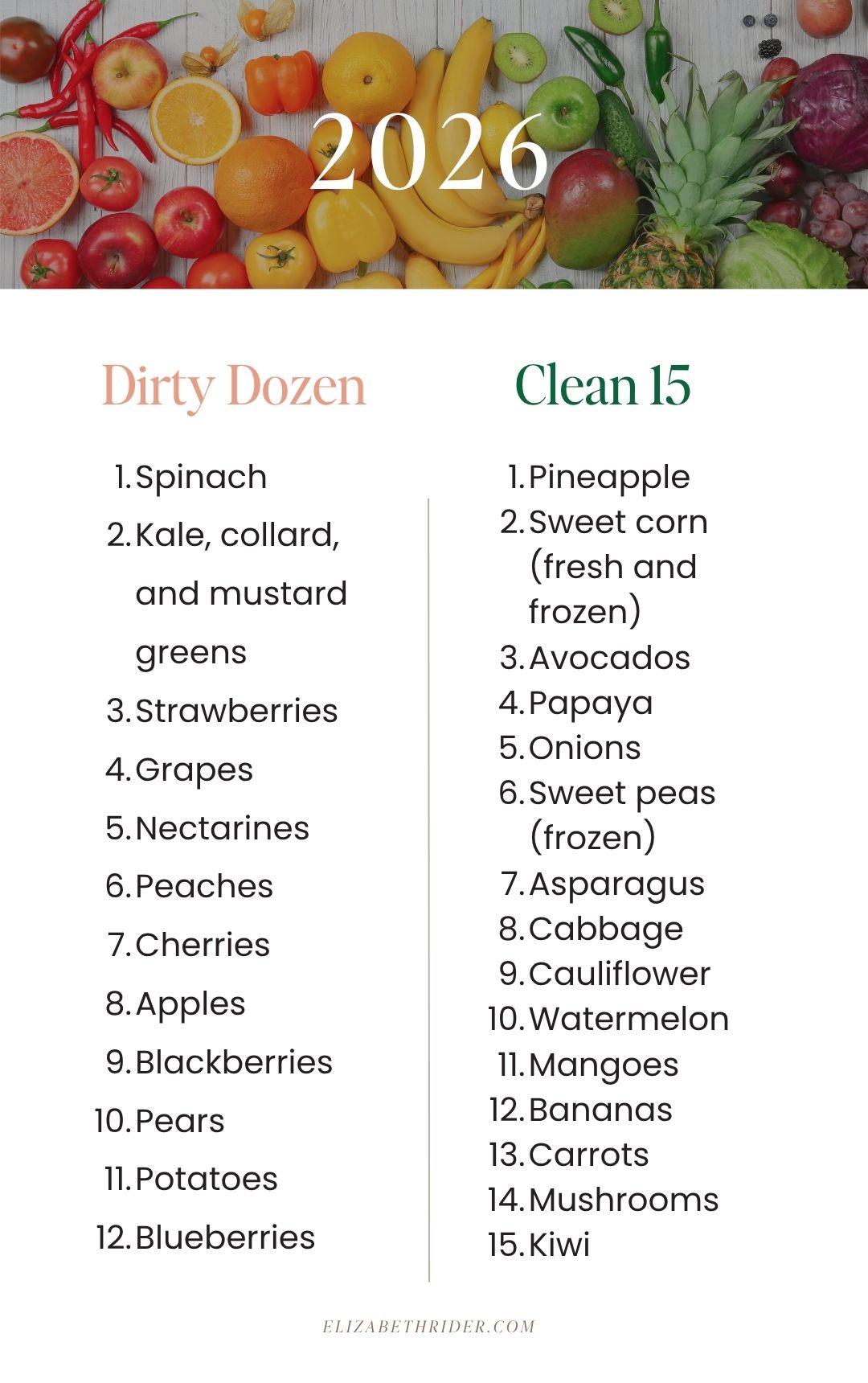
People often ask me if I buy everything organic, and I’ll be the first to admit that I don’t. While I strive to eat mostly organic and use organic ingredients when developing recipes, it’s not always practical. And when it comes to fruits and vegetables, buying organic isn’t always necessary.
When shopping at the grocery store, I rely on the Dirty Dozen and Clean 15 lists to help me decide which produce to buy organic and where I can save money buying conventional.
Dirty Dozen: These fruits and veggies are most likely to contain pesticide residues. If you want to reduce your exposure, buy organic versions of these whenever possible.
Clean 15: These have the least pesticide residues. You can feel confident buying conventional versions of these.
The lists are updated every year by the Environmental Working Group (EWG), a non-profit organization dedicated to protecting human health and the environment. They analyze the latest U.S. Department of Agriculture testing data to rank produce by pesticide contamination. The 2026 report was released in March 2026.
New for 2026: For the first time, the EWG is highlighting PFAS, the “forever chemicals,” in pesticides used on produce. The most frequently detected pesticide across all fruits and vegetables this year was fludioxonil, a PFAS fungicide. This is worth paying attention to because PFAS chemicals don’t break down in the environment or in your body.
By following these lists, you can make smarter choices about when to invest in organic produce. It’s all about balancing your budget, supporting small farms, and making health-conscious decisions.
A note on small farms: Many small farms use organic practices but haven’t gone through the expensive certification process. If you’re shopping at a farmer’s market, don’t hesitate to ask farmers about their growing practices. I’ll often buy produce from small farms, even if it’s on the Dirty Dozen, if they follow organic methods but aren’t certified yet.
Save the image above to your phone for easy reference while you’re shopping.
Here are the most up-to-date Dirty Dozen and Clean 15 lists:
The Dirty Dozen (2026)
Buy these organic whenever possible:
- Spinach
- Kale, collard, and mustard greens
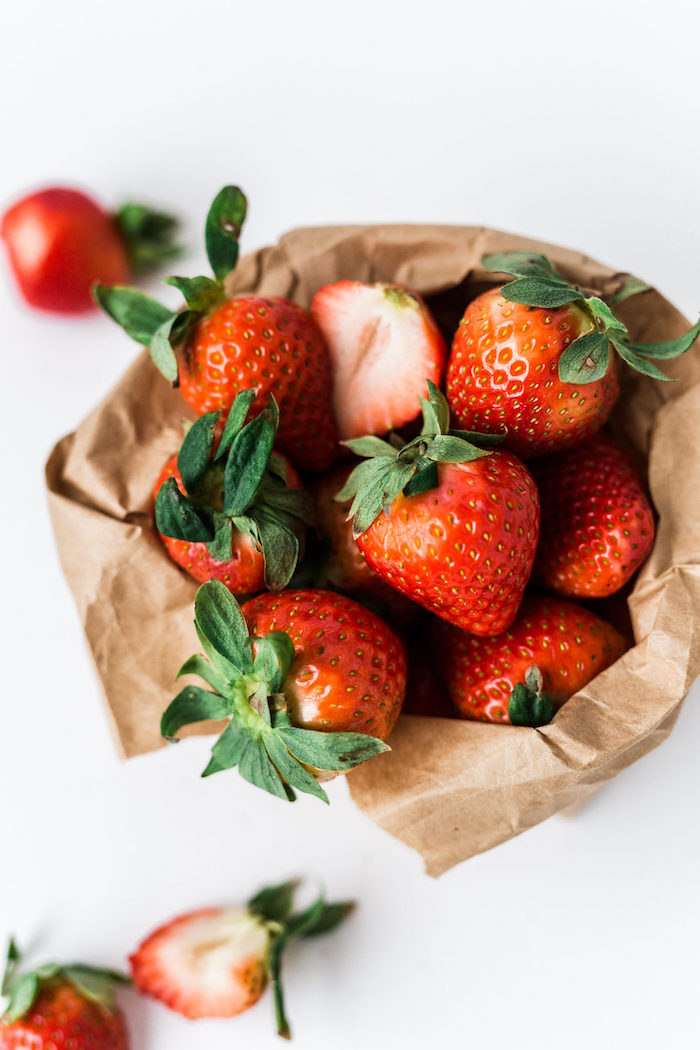
- Strawberries
- Grapes
- Nectarines
- Peaches
- Cherries
- Apples
- Blackberries
- Pears
- Potatoes
- Blueberries
Also noted for high toxicity: Bell and hot peppers, and green beans.
Key findings: 96% of Dirty Dozen samples tested positive for pesticide residues, with some samples showing up to 23 different pesticides. 75% of all non-organic produce samples contained pesticide residues.
The Clean 15 (2026)
These are safe to buy conventional (not organic):
- Pineapple
- Sweet corn (fresh and frozen)
- Avocados
- Papaya
- Onions
- Sweet peas (frozen)
- Asparagus
- Cabbage
- Cauliflower
- Watermelon
- Mangoes
- Bananas
- Carrots
- Mushrooms
- Kiwi
Key findings: Nearly 60% of Clean 15 samples had no detectable pesticide residues. Only 16% had residues of two or more pesticides. Avocados and sweet corn were the cleanest, with less than 2% of samples showing any detectable pesticides.
And yes, avocados are still near the top of the Clean 15!
What Changed in 2026
The biggest change this year is the PFAS finding. EWG’s analysis found that PFAS-based pesticides, specifically fludioxonil, were the most commonly detected pesticide across all produce tested. PFAS chemicals are called “forever chemicals” because they don’t break down naturally, and they can accumulate in your body over time. Buying organic is one way to reduce your exposure.
The Dirty Dozen order also shifted slightly from 2025. Spinach and kale moved above strawberries this year, and the overall rankings now factor in toxicity levels along with residue counts, giving a more complete picture of risk.
Full Produce Ranking (Dirtiest to Cleanest)
For those who want the complete picture, here’s the full ranked list of 47 fruits and vegetables from dirtiest (#1) to cleanest (#47):
- Spinach
- Kale, collard, and mustard greens
- Strawberries
- Grapes
- Nectarines
- Peaches
- Cherries
- Apples
- Blackberries
- Pears
- Potatoes
- Blueberries
- Bell and hot peppers
- Green beans
- Tangerines
- Cucumbers
- Celery
- Lettuce
- Winter squash
- Plums
- Tomatoes
- Cherry tomatoes
- Tomatillos
- Summer squash
- Raspberries
- Oranges
- Grapefruit
- Eggplant
- Snap peas
- Sweet potatoes
- Cantaloupe
- Broccoli
- Kiwi
- Mushrooms
- Carrots
- Mangoes
- Bananas
- Cauliflower
- Watermelon
- Cabbage
- Asparagus
- Sweet peas (frozen)
- Onions
- Papaya
- Avocados
- Sweet corn (fresh and frozen)
- Pineapple (cleanest)
For me, the closer the produce is to the Clean 15, the more comfortable I feel buying conventional. I also look at the price. If the organic version doesn’t cost a lot more, I’ll go organic anyway. Bananas are a good example. They didn’t make the Clean 15, but they’re close (#37). Organic bananas are usually about twenty cents more per pound at my grocery store, so I still buy organic. But mangoes and watermelons can get expensive, and they’re close enough to the Clean 15 that I feel good about the conventional ones.
How to Use These Lists
Keep these lists saved on your phone (I save the images above to my favorites folder on my iPhone for easy access at the store). Here’s my general approach:
- For Dirty Dozen items: Buy organic whenever your budget allows. If organic isn’t available or is way more expensive, buy conventional and wash thoroughly. Fresh produce, even conventional, is always better than no produce.
- For Clean 15 items: Buy conventional and save your money for the items that matter more.
- For everything in between: Use your judgment based on price and availability. The full ranked list above can help you decide.
- A note on washing: Washing produce doesn’t necessarily remove all pesticides since some grow into the entire plant, but it can reduce your exposure. Always wash everything thoroughly, even organic produce.
- Frozen is a great option too: Frozen organic fruits and vegetables tend to be more affordable and keep for months. I almost always have frozen organic blueberries from Costco in my freezer for smoothies and other recipes.
Always do the best you can when it comes to the quality of your food. Fresh produce is always better than no produce.
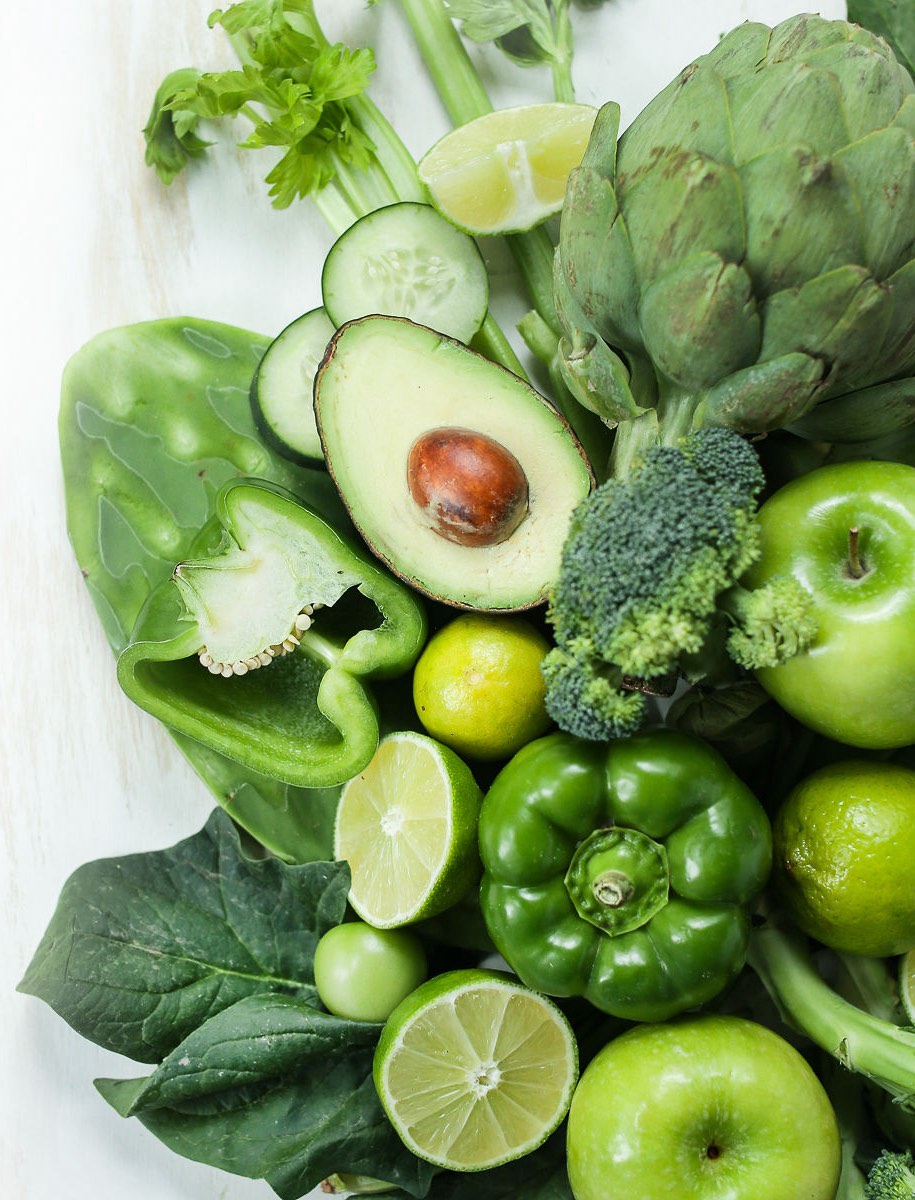










Stick to organic for the dirty dozen but save money on the clean 15.
Hi , I live in the uk . Do you know if there is a clean 15 type of list that applies to us? Thank you Julia
What about lemons?
Organic isn’t just primarily about the food. It’s a hard graft, long hours, paying a decent wage (albeit often a minimum wage!), ignoring all the cosmetic defects and generally rotating crops to avoid soil erosion.
Note that it’s not just pesticides in conventional, it’s the soil or nutrient solution they’re grown in, it’s the whole practice that may or may not be sustained, the relationships between (super)market and farmer, and the food/spray that actually goes into your food too.
I’m completely biased though – as I work in, on and around many small organic farms, as well as uncertified ones using natural methods.
Great post though – I’m no saint and my diet isn’t 100% organic either. Another source in addition to the EWG would be beneficial, for confirmation that the post is accurate and referenced.
Keep up the good work!
Hello. Great post. I’m vegan, and not always able to get organic produce. So I’m always soaking my veggies and fruits. At least a good washing. Your list helps me figure out what’s the dirtest ones. It’s always better to be safe than sorry. Thank again!!
In addition to the contaminants, I also buy organic produce like celery, onions, potatoes (and occasional others) because they keep longer…significantly longer.
How was broccoli on the clean list? Is this really correct?
Wow…. I had not heard of the dirty dozen & the clean 15 until tonight at a nutrition class. Thank you EWG for providing us with a tested list of healthy & not so healthy foods.
What about Brussel sprouts? Clean or go organic?
When these foods are tested, do they just test the outside or the entire fruit and veggie? Is there an article that explains their methodology and results?
I believe they peel and wash according to normal use.
Thank you. Although my husband and I raised two kids with Healthy nutrition in the 80s we both ended up with cancer. Now in our 60s planning meals is like a chemistry lesson! We both struggle with gout so we need low purines I have Hashimoto’s thyroiditis so I have to be careful with cruciferous vegetables and raw at that!! Then there are night-shade’s. I’ve had arthritis and gout since I was 15 and now my husband , who is a musician , seems to be developing it in his hands. Can you recommend a cookbook or a site I could go to that would cover all these issues? I do use Sally Fallon’s ,Nourishing Traditions along with Healing with Whole Foods and the New Yiddish cookbook. Great books all, thank you for your time and energy, Jodi G
Have you looked at the gaps diet, by Dr. Natasha Campbell Bride? Gut and physiology syndrome. You can purchase on Amazon. Amazing book! Would deffinetly help you both, I’m positive!
Hi Jody. Your post is from 2019 and we are now into 2023. Not sure if you get this or if you are still in need of suggestions. But if others read it also…here it is:
First of all I have had Rheumatoid Arthritis for many years but have been just recently diagnosed with Hashimoto’s also, and I am 76. I do not take any pharmaceutical drugs. But I do take some supplements. My RA symptoms are almost non-existent. Here is what has worked for me: I have been putting Organic Capers (Costco) in/and on almost everything I ate (2-3 Tblsp first and then only about 1 Tblsp.) Capers have the highest amount of Quercetin, a potent anti-inflammatory. It took only 2-3 days before I started to feel a difference. Find your dosage and research it for yourself. However, it does not cure it but will put your symptoms in remission. To cure RA you need to heal your gut, and that can take a year maybe.
In regards to Hashimoto’s, I have ordered Beef NDT (Natural Desccecated Thyroid) from LiveGivingStore.com. Haven’t received it yet but after lots of research NDT is the way to go. I have started an AIP (Auto Immune Paleo) diet (with lots of cheating so far). From my research, the NDT and the AIP do heal your gut and therewith Hashimoto’s and RA. There are lots of AIP recipes online. Also, check into the website “Stop the Thyroid Madness” for Hashimoto’s. All the best.
Hi Jodi,
Not sure you’ll get this 4-5 years later, but I’d highly recommend you look into these specialists online (lots of free YouTube talks, interviews, and documentaries):
T. Colín Campbell, Ph.D.
Dr. John McDougall
Dr. Caldwell Esselstyn Jr.
Dr. Neal Barnard
Dr. Dean Ornish
Dr. Michael Klaper
Alan Goldhamer, DC
Jeff Novick, MS RDN
[there are several more, but this is enough to get started … the top three on this list are the top specialists]
I wish I had known all this way before I did, but I at least found out before it was too late for me. I’m in my mid sixties, and changed my lifestyle 4 years ago. Some things (symptoms, conditions, and issues) went away practically immediately – others took longer – and some a couple of years). I feel great, have lost 80 lbs, and I’m never going back to a life of suffering.
Noticed that sweet bell peppers are not on the clean nor dirty list? Were they not often on the dirty list?
Hi Sur, I think they used to be, but it changes each year. You can head over to the EWG report (linked above in the post) to see where they stand now. ~E
Your blog and recipes look so interesting! Is there a way that you could support the ability to print out an article or a recipe in a direct and simple concise way? I did find one print button on the chicken bone broth but that still would only print out in a very broken pattern with much unneeded material. Thank you.
Hello Elizabeth
Any idea why broccoli is considered clean? Bananas and avocados make sense, pesticide can’t penetrate thick peels. But how did broccoli make the clean list and do you recommend buying organic?
What about bio sludge the effect on non organic produce ? I can’t seem to find any info on that
Hello. Did you know that you wouldn’t have to have 13 items in your dirty “dozen” if you didn’t list grapes twice. Dozen 12 not 13!! A simple glance at what you just listed would have allowed you to keep it a dozen.
Hi Elizabeth,
I am hosting an online show titled “Wellness your Way – Take charge of your health to increase your energy, lose weight and feel great!” Your work fits so well with the theme of my show. Would you be interested in being a speaker? if so, can we talk briefly so I can give you more details?
Thanks, Liz
Hi Liz! Please send all requests through the contact form. You can find it in the menu of this website. Thanks!
I’m so happy I just found your post. As we live on a tropic Island it’s hard work for us//not that easy to get No-GMO and pesticide-free veggies and fruits. So finding your list is very precious for us. . Thank you so much for this info. Just we have some questions….still.
Which one list belong “Purple Cabbage” in? The same for red onion? Looking forwards for your reaction. Thanks
I’m so happy I just found your post. As we live on a tropic Island it’s hard work for us//not that easy to get No-GMO and pesticide-free veggies. So finding your list is very precious for us, . thank you so much for this. Just we have some questions….still.
Which one list belong “Purple Cabbage” in? The same for red onion? Looking forwards for your reaction. Thanks
The EWG also puts out a free app with both sets of lists! It’s called “Dirty Dozen”!
Great article Elizabeth. Question about grapes – I have been assuming that since grapes are on the dirty dozen, I should strive to only drink organic wine. Is that true or is there anything in the process of making wine that would make that unnecessary?
Such a great question! SO much goes into the winemaking process and I’m not an expert, but, yes, in general I think it’s better to choose wine that is made from organic grapes. Organic (and biodynamic) wines are becoming more and more available. Here is a great article that discusses it more: http://blog.foodnetwork.com/healthyeats/2015/03/11/is-organic-wine-better-for-you/
-Elizabeth
Thank you, and appreciate the helpful article!